Showing posts with label Music Learning. Show all posts

Saturday, November 21, 2020

5 Ways to Extend your Vocal Range

Can you really extend your vocal range? The simple answer is YES!


Whether you've been singing for years or days, you can always work on developing your vocal range. And unless you are able to sing with Mariah Carey’s vocal range, there is always room to grow and expand your range. Singing those hard notes with ease is the difference between an amateur and a professional singer.


In this blog, we are going to discuss five ways you can expand your vocal range without damaging your vocal cords.


1. Understand Your Abilities

Have you ever checked your vocal range?

If you haven’t, let’s see if we can figure it out together. Hop over to your keyboard or download a free mini piano app on your phone. Start with the middle C also known as the C4 as it’s the 4th C on the keyboard. So, let’s go down in pitch from here to see your low range. Make sure to right down the pitch name when you reach your limit. Once you have found the lowest note on your vocal range, let’s figure out the highest. Let’s go up in pitch from here to see your high range. Make sure to right down the pitch name when you reach your limit.


It's important to know that your vocal range isn't the highest and lowest notes you're able to belt out. Your vocal range actually exists somewhere between the lowest notes and highest notes you can sing comfortably and consistently.


Some people ask, Is it possible to increase your vocal range by one octave? Yes, but it is quite a big task. Your vocal cords are only capable of so much. However, a lot of that depends on how developed and trained your vocals currently are. If you've never taken the time to practice singing, you will likely notice a significantly broader range of pitches that you can hit once you begin training. If you have been singing for a long time but have just recently decided you'd like to expand your range, it will probably not grow quite as much as a novice.


2. Use Proper Technique

It's very dangerous to extend your vocal range without employing proper singing techniques.

Using the wrong technique, or no technique at all, can result in injury to your vocal cords.

Here are some of the basics to be mindful of:

Good posture is very important. Stand up straight and make good use of your breath support. Don’t compromise your posture as this tends to put stress on different parts of your body ultimately impacting your breathing and therefore your singing.

Breath from your diaphragm instead of your neck and shoulders - When new vocalists sing outside of their normal vocal range, they tend to force more air through the throat, which will jam up their vocal cords, or restrict air flow, which will lead to a breathy sound.


Maintaining the proper technique will help you avoid those situations.


3. Practice Regularly

The best things in life take time, right? Simply put, expanding your vocal range won't happen overnight. The hardest part for most vocalists isn't the vocal range exercises, it's having the patience to wait. With consistent exercise, you're doing much more than just trying to add a few notes to your range. You might not be able to hit that stubborn high note, but you'll notice your voice becoming stronger and lasting longer than when you first started doing the exercises.

You'll also notice on your good days that notes come out much clearer and with much more confidence.


I also want to request you not to overdo the exercises. Be patient while trying to expand your range and don’t overdo it. Don't try too hard during a warm-up, practice, or a performance. If your voice gets tired, try more low impact warm-ups like lips rolls or humming to avoid any irritation. If it feels bad, don’t do it. Pushing through strain or not giving yourself enough rest when you need it can damage your vocal cords and set you back further than if you would've just taken a break. Never try to sing through pain, and don't feel guilty about needing to skip a day or two to protect your voice. A rest is as important as a practice day - you should definitely give your voice rest for one day a week. Be patient, protect yourself, and take care of your vocal cords.


4. Take care of your Vocal Health

Singers have gotten a bad reputation for not taking care of their vocal cords. Many of us are guilty of this. It's easy to talk too loud at a party, over-sing at a show, or cram in too many practices before the next big performance comes up. It's not always possible to keep your vocal cords in perfect health, but there are a few things to do to make sure you prioritise your vocal health. Try to get a good night's sleep. 7-9 hours a night is ideal. Try to drink at least plenty of water throughout the day to stay hydrated. Protect yourself from viruses by washing your hands and using sanitiser as needed.


There are also certain foods and drinks you should avoid before you sing. Any food or drink that dries your throat, like coffee and alcohol, should be avoided. That being said, also avoid foods and drinks that can create mucus to your throat, like most dairy products and sugar. One important tip: Most singers opt for water leading up to, and the day of, a show. While this is strongly recommended, there is a catch. Try to stay away from ice cold water. It restricts your throat and can cause tension. Want to know a simple tip? If you don't have access to a ton of water but need to hydrate, steaming has been proven to be very effective. You don't have to avoid these things all of the time, but avoid them before you sing, because singing through dryness, mucus, or constriction will cause significant strain on your vocal cords.


5. Vocal Exercises 

Here are some simple exercises that can help work on your vocal range. Start from middle C or C4 and sing every note (including the black ones) in sequence until you cannot sing anymore. Do this for both the higher pitch and lower pitch notes. Ideally, do this exercise 3-5 times depending on how much time you have and how you feel (remember, never sing through pain - it will only get worse!). Do this regularly to see a real improvement in your vocal range. Here's a video link to the vocal exercises - https://youtu.be/cKkrHf6GAr8


Finally, one very important point – while developing and working on your vocal range is really good - vocal range isn’t the most important criteria when it comes to vocal performance. Of course, it helps. However, some famous singers don’t have very big vocal ranges and yet produce incredible music – take for instance Adele. Her vocal range is just 2 octaves but what she does with it is what makes her noteworthy.


If you want access to detailed guided practice routines, do check out our lessons on musicpandit.com for access to step-by-step lessons that cover a whole lot of topics like vocal projection, improvisation, vocal vibrato and so much more.


We hope you enjoyed this topic and it was useful to you. If you want to know more about such topics, please comment below and we will definitely address it. Please make sure you follow our blogspot to get access to more such content.


Music Pandit brings you the best and the most effective way to learn music online with a complete 360-degree approach to learning music.

Music Pandit offers Online Video Lessons with the support of Personalised feedback from our Music Pandits, curated step-by-step lessons, extensive content - you can choose multiple instruments, carefully organised Practice Routines, a Musical Community, Creative Challenges, Goal setting and so much more – so you can learn Anytime, Anywhere at your pace! Sign up today on https://musicpandit.com 

Saturday, October 3, 2020

5 Things to do to Start Singing Right Now

Do you love to sing? Or do you have a song in your head that you dream of singing? Whether you wish to perform on a stage someday or you just want to step up your shower singing skills, anyone can learn how to sing better.


A common misconception about singing well is that you’re either born with it or you’re not. Well, we believe that ‘anyone can sing’ and we are going to tell you how!


In this blog, we will discuss 5 things you need to know to start your singing journey right now!


#1 A Singer is a Vocal Athlete

Singing is actually comparable to any athletic endeavour – let’s take for instance training for a performance, we can compare it to training for a marathon. There are certain muscles that need to be worked out and we push ourselves a little more every day to build up our endurance.


The same thing is applied when singing, we work out several parts of our vocal anatomy including vocal cords, larynx and soft palate. The more regularly you do this, the better control and flexibility you will have over your voice.


While physiological differences do play a role in the tone of the voice, the fact is that vocal training can make all the difference between an amateur singer and a professional.


#2 Stay Motivated

Now, when you are starting to sing, you will come across many nay-sayers. Everyone encounters negative people who constantly discourage you.


But, try to remember why you started in the first place. Who was that person or What was that song that made you want to sing?


Don’t forget it.


No singer was great when they started their musical journey, every one of them worked hard and didn’t give in to their critics and that’s why they got where they are.


Remember ‘you don’t have to be great to start but you have to start to be great.’


#3 Breathing Technique

One of the most important fundamentals to get right when you sing is your breathing technique. This is what makes the difference sounding breathless to holding that note with ease.


For singers, the technique of breathing through the diaphragm of belly breath is essential in order to deliver better and more stable sound.

If you don’t know how, try this technique. Put your hands (one on top of the other) on your belly, with the center of your lower hand touching your navel. Watch how your breathing responds. You may notice that your belly wants to expand as you inhale and retract as you exhale. Let this happen, but don’t try to force it.


The best way to practice this exercise is while lying in bed. Place your hands lightly on your stomach and watch as your belly expands and contracts with your breathing.


#4 Posture

When singing posture is one another important piece of the puzzle. So, let’s talk about how you can maintain the right posture while singing.


Whether you are standing or sitting, there is a way that you can ensure that your breathing and your singing resonance does not get disturbed.


Starting from the top, your chin should be parallel to the floor and slightly tucked in or back. hold your chest high and your shoulders down or slightly back. Keep your tummy both firm and expandable at the same time. You will need to practice controlling these muscles while learning how to breathe using your diaphragm.


Singing while standing is the best posture so that your tummy or lung area is not being crushed and you have enough room to move freely. Your hands should be relaxed and held still at your side. Do not hunch or lean backwards, stand straight.


Singing while sitting is not the ideal posture, however, if you need to sit, please ensure that your back is straight and not hunched forward or leaning backward. Your tummy and lung are should not be crushed.


#5 Easy Warm Up Exercises


Lip Rolls

Lip Rolls are a great way to warm up. They get blood flowing to the vocal chords, and around the mouth area increasing flexibility. Other variations of Lip Rolls are great exercise to ensure smooth transitions between Chest Voice, Head Voice and Mix Voice.


How to do a proper Lip Roll

  1. Gently place your fingers on each cheek

  2. Lift up and, depending on preference, move your fingers slightly forward or pull back

  3. Blow*


*Keep your lips loose! You want the air flow to allow them to vibrate against each other. Repeat this 4-5 times to ensure your lips mouth region gets warmed up and flexible.


Moving Up & Down the Keyboard

Starting from the middle C (or the 3rd C on the keyboard), move slowly towards the left or the lower pitch. Go as far as you can without straining too much or hurting your voice. Similarly, do this with the upper range. Do this a few times to wake up and warm up your voice so that it is nice and clear. You voice will also feel more flexible and in control.


So, there you have it. Our 5 pointers to begin your singing journey today! If you want to see a video demonstration of these topics, please see the video on our YouTube channel - https://youtu.be/t77WUmix7hw


If you want access to detailed guided lessons and practice routines, do check out our Western Vocals lessons on https://musicpandit.com -  On Music Pandit, you get access to step-by-step lessons that cover a whole lot of topics like improving your vocal range, vocal projection, improvisation, vocal vibrato and so much more.


We hope you enjoyed this topic and it was useful to you. So, please follow our blog so you don’t miss out on any upcoming blog posts. If there is any topic you want to know more about, just comment below and we will definitely discuss it.


Music Pandit brings you the best and the most effective way to learn music online with a complete 360-degree approach to learning music.


Music Pandit offers Online Video Lessons with the support of Personalised feedback from our Music Pandits, curated step-by-step lessons, extensive content - you can choose multiple instruments, carefully organised Practice Routines, a Musical Community, Creative Challenges, Goal setting and so much more – so you can learn Anytime, Anywhere at your pace! Sign up today on https://musicpandit.com 

Saturday, June 20, 2020

Online vs. Offline – What is the Right Way to Learn Music?

There are so many online music courses on the internet today but how do you know if they are any good? But then again, if you are going to a Music School in your city, you might not have the time to attend those music classes. So, what is the best option to learn music?


Online Music Education


Advantages 


  1. Flexibility: can pursue your music lessons at your own time and in your own pace, there aren't strict time constraints. So, you can adjust your time from your schedule and put your free time towards learning music.
  2. Organised Lessons: Because the lessons are pre-recorded, they are usually very crisp and clear, it does not change with teachers, accents or moods. The lessons are designed with a clear objective and everything essential to your learning is available in the lessons. All the theory and concepts surrounding the topic are all covered in the lesson.
  3. Practice Routines: You get structured practice routines to help you develop specific skills.
  4. Affordable: Online Music Learning is much more affordable compared to a Music School or private lessons.
  5. No Teacher Issues: Online lessons usually have good instructors who are also responsible to building the course and have vast knowledge when it comes to the topic. Instructors will be available anytime as the lessons are readily available and thus ensuring that you don’t have any challenges when it comes to your learning. Finally, the instructor’s mood and behaviour will be consistent and motivating throughout the course unlike in real life – thus ensuring you have a smooth learning experience.
  6. Multiple Subjects: You have many options when it comes to choosing an instrument in the online learning model. Websites can provide any number of courses that allow students to pick their favourite instruments or topics and learn.
  7. High Quality Video Lessons: the great thing about online music lessons, especially the pre-recorded classes is that the content is easy to view and understand. Unlike online LIVE sessions, there are no internet issues, lags or drop-offs.


Disadvantages


  1. No Instant Feedback: The drawback to online curriculum is the feedback system. There is a process involved for direct interaction through online and sometimes can be frustrating and time consuming. However, on platforms like Music Pandit, you will get personalised feedback in 24 hours.


Music school (Offline)


Advantages 


  1. Personal Interaction & Feedback: It allows direct interaction with your instructor. Every lesson can be immediately provided with feedback, so if you have any doubts or questions, it can be resolved right there.
  2. Network: You may meet fellow musicians who are at the same level as you. It is really healthy and fun to socialise with your peers as it encourages growth and more interest in that particular subject.
  3. Performance: You may perform as a part of the music school or with your peer group.


Disadvantages


  1. Less Subject Options: A Music school will only be able to provide a limited portfolio of subjects due to difficultly in getting specialised instruments and instructors.
  2. No Flexibility: If you are a working adult or learning in school or college, you might not get much time to go for music classes and the timings won’t be very flexible.
  3. Monotonous: It requires commitment as you may be rehearsed through the same drills again and again, especially if you are a beginner which, might make the sessions little monotonous.
  4. Instructor Issues: The teacher may not be very skilled and have limited knowledge. The teacher may be irregular due to other commitments like personal classes and shows. The teacher may not be in a good mood some days and can thus affect the learning of that day.


Conclusion

In conclusion, it is really useful to consider the benefits and dis-advantages before embarking on your music learning journey. It is good to ensure that your goals align with the method of teaching, affordability and the time required. 


Music Pandit brings you the best and the most effective way to learn music online with a complete 360-degree approach to learning music.

Music Pandit offers Online Video Lessons with the support of Personalised feedback from our Music Pandits, curated step-by-step lessons, extensive content - you can choose multiple instruments with One subscription, carefully organised Practice Routines, a Musical Community, Creative ChallengesGoal setting and so much more – so you can learn Anytime, Anywhere at your pace! Sign up today on https://musicpandit.com 

Saturday, May 9, 2020

4 Ways That Learning Music Make You Smarter

There are numerous substantiations about the role Music education can play mental and social development, as well as life lasting communication skills. In this article, let us look into the impact music education can have on brain development and stimulation.

1. Heightened Brain Development

When playing an instrument , it requires the attention of our brain which opens up several neural path in brain that helps in developing the brain. It undergoes various mental activity that keeps the brain active and drilled for complicated arrangements so that it can solve and react to  the things as quickly as possible. Somehow the architecture of the brain changes in a way that it starts perceiving tasks in a broader, smarter and emotional way. Thus, regularly practising music heightens the processing ability of our brain and it tends to decipher complex activities with ease and efficiency. Listening to music and playing music is considered the equivalent of a full-body workout for your brain!

2. Stronger Memory Power

Music education pushes you to understand certain capabilities of the brain, most importantly - the ability to memorise in innovative ways. It can teach you to analyse the task at hand and process the data in a way that helps you connect them with relation to its purpose. This way, when you can connect the dots, it helps you remember things better. It also enhances your spatial, auditory and visual capacity that helps you comprehend things much better.


3. Enhanced Cognition and Co-ordination ability

Playing an instrument requires concentration and conscious attention to details. It also requires a lot of coordination to be able to execute the playing accurately. So, with regular practice you can develop your coordinating abilities that will enhance your skills in the instrument, but also it will help you tackle other activities that you come across in your daily life that requires you to have some type of coordination. Practicing music is like a workout of your brain, so you are building muscles which will store more information as well as react more efficiently to the tasks given. Thus, it also improves your cognitive abilities which helps you retain things better, plan effectively and focus your attention to the necessary.

4. Faster ability to learn

As we have seen from the points discussed above, music really plays a vital role in the development and enhancement of our intelligence. It is safe to say that, if one has successfully done their music education, it can help them in long-term. They have a higher sense of conscience, consciousness, enhanced cognitive and spatial capacity and a broader sense of how things work. It prepares you for all the challenges that may come your way. You tend to learn about your surrounding faster and take the reasonable action necessary. It provides you the ability to learn things faster and use them to benefit your skills.

Music does not only make you smarter, it supports you emotionally as well. It can be one of the most supportive base that you can rely on. It also provides you with so many benefits that can improve your emotional life. Finally, the reason one should consider learning music is not just because of all the benefits stated above, but also for the simple joy you get by listening to music and playing music.

Sunday, April 12, 2020

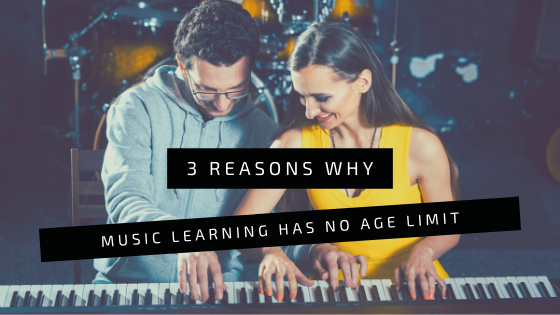
3 Reasons Why Music Learning has no age limit

Music is a universal language. Music has no boundaries. And, it can reach huge masses. Music has the ability to connect with you emotionally, spiritually as well as provide the best company when you need it.

Almost every person loves to listen to music, so if you wish to learn it, your age should definitely not stop you from learning or playing music. There is no age limit to learn music, all it requires is your time and patience and you will be playing tunes in no time.

Virtue of Patience
You might have heard the classic stereotypes where they say it is harder for older people to absorb things quicker. It is not entirely true. Modern day requirements put a lot of stress in an individual and it deprives them of valuable time that is required for themselves. Studies have proved that learning music is one really good way for both adults and kids to deal with stress and anxiety. Additionally, you are spending time learning something new! Learning music has benefits for all, age has nothing to do with it. While it can help develop a kid's cognitive ability and personality, it can act as a stress buster for adults.


If you are starting music learning as an adult, you do need to be little bit more patience. The reason is that it requires more time compared to the youth, who are already used to learning things every day, from their daily co-curricular activity. However, as long as you want to learn, there is nothing stopping you. So, set aside some time today and check out https://musicpandit.com/


Universal Language
Music can be understood by all. It is perceived and felt by all from different ages. If you wish to play along your favourite music or create your own, it is never too late in music. All you have to do is find time for practice from your schedule, follow the exercise and lessons and learn the practicality of it. Just a little commitment from your side and your dream to play a musical instrument will be fulfilled.. Music is a gift that anyone who wishes to learn should find time and make use of it to their benefit, may it be for fun, remedy for stress or developing important personality traits.

Simple Needs
To start your learning, all you need is an instrument at home and assigned time for practice. Those are the ingredients for learning, your age has absolutely nothing to do with it perhaps only your daily schedule can decide if you can give your time. It is an amazing outlet for those who wants to free themselves from the stressful monotony of their everyday life. Everyone has a different pace and system in learning something, but we assure you it’s not about the age, it is all about your willingness to learn and to make it second nature for your muscles to be able to play those by sheer commitment to practice and effective repetition.

So, don’t let a simple thing like your ‘age’ be a factor in determining what you can or cannot do. Music is for everyone. Music learning is for everyone. Playing Music is for everyone. Use music to de-stress, express yourself and fulfil yourself. Live your best life.


Music Pandit brings you the best and the most effective way to learn music with a complete 360-degree approach to learning music.

Music Pandit offers Personalised feedback from our Music Pandits, curated step-by-step lessons, extensive content - you can choose multiple instruments with one subscription, carefully organised Practice routines, a Musical Community, Creative ChallengesGoal setting and so much more – so you can learn Anytime, Anywhere at your pace!


References

Monday, February 24, 2020

Music and Your Mood

Just how does music affect our mood? And how can we use music and rhythms to experience a better, more fulfilling life?

Music - It makes us smile; it excites us and makes us dance; it brings us to tears. A simple song can bring back a memory or a moment and we actually feel like we are there! Music can change our mood within minutes – or instantaneously.

Are you sad, depressed, or anxious maybe? You will be glad to know that you can chase all the blues away just by listening to your favorite music.

Because of our unique experiences, we develop different musical tastes and preferences. Despite these differences, there are some common responses to music. Babies love lullabies. Maternal singing is particularly soothing, regardless of a mom’s formal musical talents or training.


Music, Attention & Learning

Everyone who has learned their ABCs knows that it is easier to memorize a list if it is set to music. Scientific research supports common experience that pairing music with rhythm and pitch enhances learning and recall. Music helps people with attention problems in several ways.


Music, Anxiety & Stress

Considered as a natural antidepressant, music can give you the euphoric high that antidepressant medications can bring. So, if you are looking for a great way to end your terrible day, read on to learn more about how music can uplift your mood almost instantly.

Music’s beneficial effects on mental health have been known for thousands of years. Ancient philosophers from Plato to Confucius and the Kings of Israel sang the praises of music and used it to help soothe stress. Military bands use music to build confidence and courage. Sporting events provide music to rouse enthusiasm. Schoolchildren use music to memorize their ABCs. Shopping malls play music to entice consumers and keep them in the store. Dentists play music to help calm nervous patients.

Modern research supports the conventional wisdom that music benefits mood and confidence. Rhythm and tone can have an impact on your happiness – and on your everyday mood. So, listen to songs that make you feel good, that motivate you and make you happy – and you can begin to feel the effects more quickly than you imagine.

Music Pandit brings you the best and the most effective way to learn music with a complete 360-degree approach to learning music.

Music Pandit offers Personalised feedback from our Music Pandits, curated step-by-step lessons, extensive content - you can choose multiple instruments with one subscription, carefully organised Practice routines, a Musical Community, Creative Challenges, Goal setting and so much more – so you can learn Anytime, Anywhere at your pace!

Source:
http://www.healthline.com/health-news/mental-listening-to-music-lifts-or-reinforces-mood-051713
https://www.consciouslifestylemag.com/music-and-the-brain-affects-mood/
https://examinedexistence.com/how-music-changes-your-mood/
http://bestbinauralbeats.org/how-music-affects-our-mood/
https://www.healthychildren.org/English/healthy-living/emotional-wellness/Pages/Music-and-Mood.aspx
http://www.hindustantimes.com/health-and-fitness/here-s-why-music-affects-our-mood-emotions-the-way-it-does/story-QxXKOJYANFGE25X2NBxLrK.html
https://sites.psu.edu/siowfa16/2016/10/02/does-music-affect-our-moods-significantly/

Wednesday, February 12, 2020

How To Choose Your First Instrument

Are you the few ones who are eager to learn a music instrument but torn between which instrument to pick up? You want to emulate your idol and play like them? Or You want to compose your own music but not sure about which instrument will help you realising your dream? Here is a little information about the kind of instruments and a helping hand to guide you decide upon an instrument so that you can finally start your Music Journey.

Your Interest

First of all, what interests you? What are the kind of songs that you love to listen and would love to play yourself? Which instrument excites you the most? This can help you decide which instrument would best suit you.  Piano/Keyboard is very versatile and can help you compose without any limitations, whereas Guitar is the most compatible instrument you can learn. Drum would take some space but if you are a fan of hard hitting, letting your groove out on a beat, that’s the instrument for you. There are certainly many other instruments, but let’s talk about the common and popular ones. It completely depends on what you are looking for through music. You could learn vocals if you want to sing your heart out and touch a few.

Preference of Music Genres

If you are into Rock and Roll, Guitar might be the most popular choice but if you want to create rocking beats, you might as well go for Drums. Or, You are in to Pop, or electronic music, then Piano or Keyboard is the smartest choice for you. Every genre of music is dominated by an instrument or two, so do the research on your favourite songs and artists, learn about the process of making and you might discover love for a particular instrument. Which part of your favourite song would you like to imitate or learn? That will let you know what you really want to learn and play.


Practice Time Limitations

Before you begin to learn an instrument, map out your schedule. See, how you would manage the time for your regular activities and learning an instrument. Observe how much time you can give to learning an instrument, what kind of space you have for practice? If you are learning drums, make sure you have the space to occupy your drums and insulate your room so that neighbours aren’t disturbed. Also, if you are eager to learn vocals, you have to practice in a room where you can sing open heartedly with an open loud voice. There are many cheap ways to soundproof your room, you can do the research on that as well. At the beginning level, learning guitar may take some time, so make sure you have the time to regularly practice guitar. Keyboard/Piano are relatively easy in the beginning, however as you advance through higher levels, you will have to give time for any instrument to master the skills that is required to play the instrument to its fullest capability.

Budget

Different instrument would cost you differently. Although this shouldn’t be the factor that stops you from playing what you would love to learn, we will still discuss about how different instrument cost. The cheapest would be learning vocals as it doesn’t require any instruments in the beginning, as you begin to perform regularly, you might want to buy a microphone that would help you understand the dynamics of singing on a mic. Guitars can be very affordable, especially in the recent times with big brands producing low budget guitars with very decent quality, and it can serve you for a long time as well. Pianos are costly, however keyboards can be found in affordable prices but to get a good quality, long lasting instrument, you might have to cash in a little bit, but for composers, this is kind of a must have. The costliest of all the instruments can be the drums. Although you get affordable drum sets but if you are looking to invest on something that will last longer, it is an expensive instrument to buy. As it involves a lot of different parts as well, the price would depend on what are you buying in the drum set. As we discussed, Budget should not be a factor in deciding what instrument you want to learn, as the investment you are making will serve you for far more benefits than loss if you are really interested in learning and playing the instrument. One thing is for sure, if you have the desire to learn, you will not regret doing the investment on the instrument you would love to learn.  


Music Pandit brings you the best and the most effective way to learn music with a complete 360-degree approach to learning music.

Music Pandit offers Personalised feedback from our Music Pandits, curated step-by-step lessons, extensive content - you can choose multiple instruments with one subscription, carefully organised Practice routines, a Musical Community, Creative Challenges, Goal setting and so much more – so you can learn Anytime, Anywhere at your pace!

5 Tips to Choose the Right Song for Your Voice

What is the right song to sing to showcase your musical talent to an audience? This is a question you must consider as a performer especiall...